
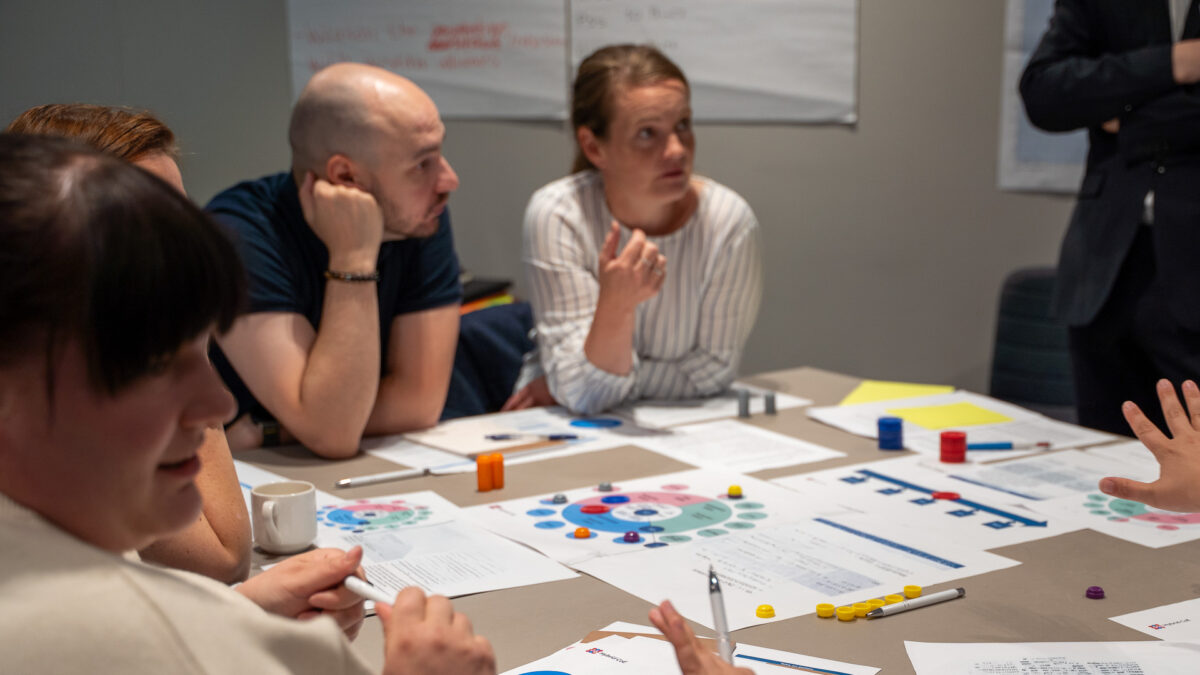
Modern wargaming is a uniquely hands-on and immersive learning experience for participants. It offers many advantages over passive learning, including real-time knowledge transfer and in-person decision making.
Hybrid CoE regularly invites international experts to participate in wargaming courses, simulations and exercises that model a hybrid threat environment. These events teach participants to incorporate hybrid threat activity into their planning process while addressing the potential vulnerabilities within democratic societies.
Through the eyes of a threat actor
In August 2026 practitioners from Hybrid CoE’s Participating States and organizations convened in Helsinki to design and test various wargames. The wargaming course followed a train-the-trainer approach, in which participants incorporate real-world lessons learned in designing their games.
The simulations enabled players to represent adversarial factions aiming to disrupt democratic societies through various hybrid threat activities. By gaining an insight into a threat actor’s perspective and the actions available to them, participants developed their ability to identify weaknesses, seek creative solutions and share best practices.
A complex hybrid threat environment
As a member of a group focusing on hybrid threats at the Czech Ministry of Defence, David Anthony Prochazka attended the course to uncover the perspectives a traditional wargame cannot provide.
“A hybrid environment gives you many more possibilities and different combinations, focusing not only on classic military operations but also on economic pressure and cyber operations,” Prochazka explains.
He describes traditional wargaming as a very structured exercise that offers a limited range of scenarios. In the hybrid world the combination of actors and courses of action produces unexpected results. This can give practitioners an edge.
Learning from different perspectives
The simulations’ highly focused and practical nature also makes them an effective platform for connecting with the wider network. Beyond new contacts, practitioners often leave with friends.
There was a considerable diversity of experts present, as the event was attended by professionals with various backgrounds from across the Euro-Atlantic region. For example, a civilian’s perspective could be complemented by working with military personnel, and vice versa.
Hybrid threat wargaming as a tool for creative learning
Jenny Lindqvist, who manages the Moldova programme at the Folke Bernadotte Academy in Sweden, was intrigued by gaming’s potential as a tool for learning, building resilience against hybrid threats and promoting democratic governance.
“Wargaming is a good way to exchange practical experiences in a safe environment, extract knowledge, think creatively outside the box, and apply this competence in everyday work. It’s inspiring,” Lindqvist says.
While the Centre’s events provide a substantial theoretical background, many participants agree that the core benefits are in the practical application of that knowledge: creating a game that can leverage expert information for analytical purposes.
The right simulation for the right purpose
During the two-week course participants explored various types of hybrid threat wargames, alternating between playability and realism. David Anthony Prochazka notes that each game is a trade-off between the two, and the purpose of the game determines which is more important. “If it’s more to train, it’s probably more playable. If it’s more about the analytical part, it’s more realistic, but harder to learn.”
It can occasionally be challenging to keep the goals of the exercise in mind. A game may be designed to study hybrid campaigns in a specific region or country, but it can be easy to lose track of these aims during an intensive session. Fortunately, the course instructors support participants in ensuring their simulations have analytical value.
Resilience training as a strategic necessity
Simulated scenarios are a particularly effective tool in navigating a tense and volatile geopolitical environment. Recent events involving state actors have demonstrated that robust hybrid threat resilience training is no longer optional but a strategic imperative.
The Centre’s simulations draw on the Comprehensive Resilience Ecosystem (CORE) model, in which threat actors may use various tools to attack different domains undermining the foundations of a democratic society. The model emphasizes a whole-of-society approach to countering hybrid threats.
Simulating new and developing threats
In a changing environment wargames can help understand incidents that have already taken place, as well as exploring new and developing threats like AI-assisted attacks. The games expose players to unpredictable scenarios that test their understanding of hybrid threats.
Wargaming a hybrid environment can be a humbling experience. A designer may prepare for countless outcomes yet still find players instantly coming up with something unexpected. It’s a process that improves with the ideas formulated by an international field of experts.
Hybrid CoE’s hybrid threat wargames:
- Merge the knowledge of hybrid threats and resilience with the art of wargaming
- Offer practical tools and techniques for addressing hybrid threats
- Test decision-making skills during a conflict or in a competitive environment
- Help prevent escalation by studying hybrid activity that may lead to violent conflict
- Explain the concept and effects of hybrid threats to a diverse audience
- Clarify the importance of a whole-of-society approach and cross-organizational collaboration
- Build connections with a network of colleagues across the Euro-Atlantic region
- Transfer skills learned to colleagues through a train-the-trainer programme.