
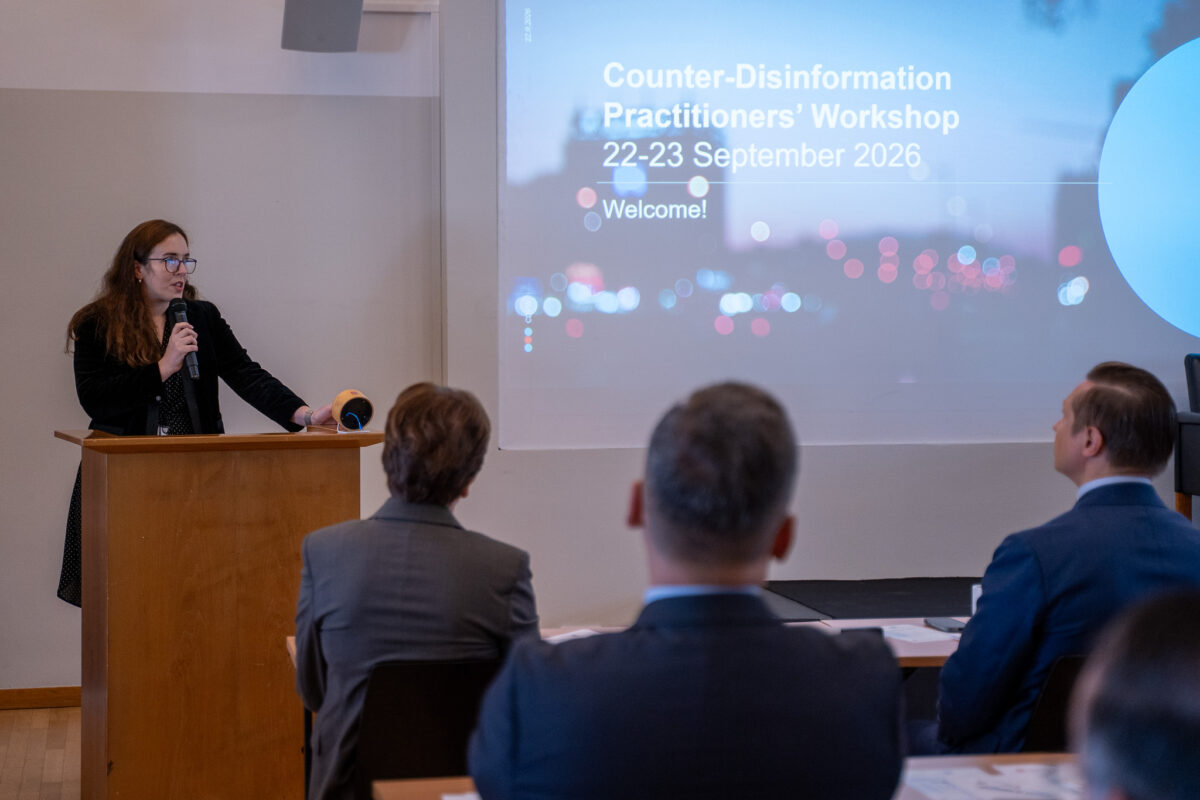
In September, representatives from 25 Participating States, the EU and NATO attended Hybrid CoE’s annual Counter-Disinformation Practitioners’ Workshop (CDPW). The workshop approached disinformation from various perspectives, addressing strategic approaches, regional trends, responses, and the role of new technologies.
Participants were welcomed by Dr Teija Tiilikainen, Director of Hybrid CoE, and Martha Turnbull, Director of the Community of Interest on Hybrid Influence. Dr Tiilikainen highlighted the scale of the challenge that disinformation poses: democratic societies’ adversaries are engaged in activities that extend from individual narratives to the cognitive level, mirroring the Soviet-era concept of reflexive control.
Disinformation as a tool for shaping the world order
Paul Baines, Professor of Political Marketing at the University of Leicester, has conducted research on political marketing and propaganda in marketing communications. In his talk, Professor Baines noted the proportional effectiveness of modern disinformation tools: despite being relatively cheap, easy to produce and even “silly”, many campaigns can still have an impact.
According to Professor Baines, both Russia and China use disinformation as part of an effort to shift the world order in their favour. Russia directs its attacks at the foundations of democratic systems, as evident in recent campaigns to influence European elections. In addition to notable activity against Taiwan, China has launched an ambitious campaign to shape the information environment in its favour.
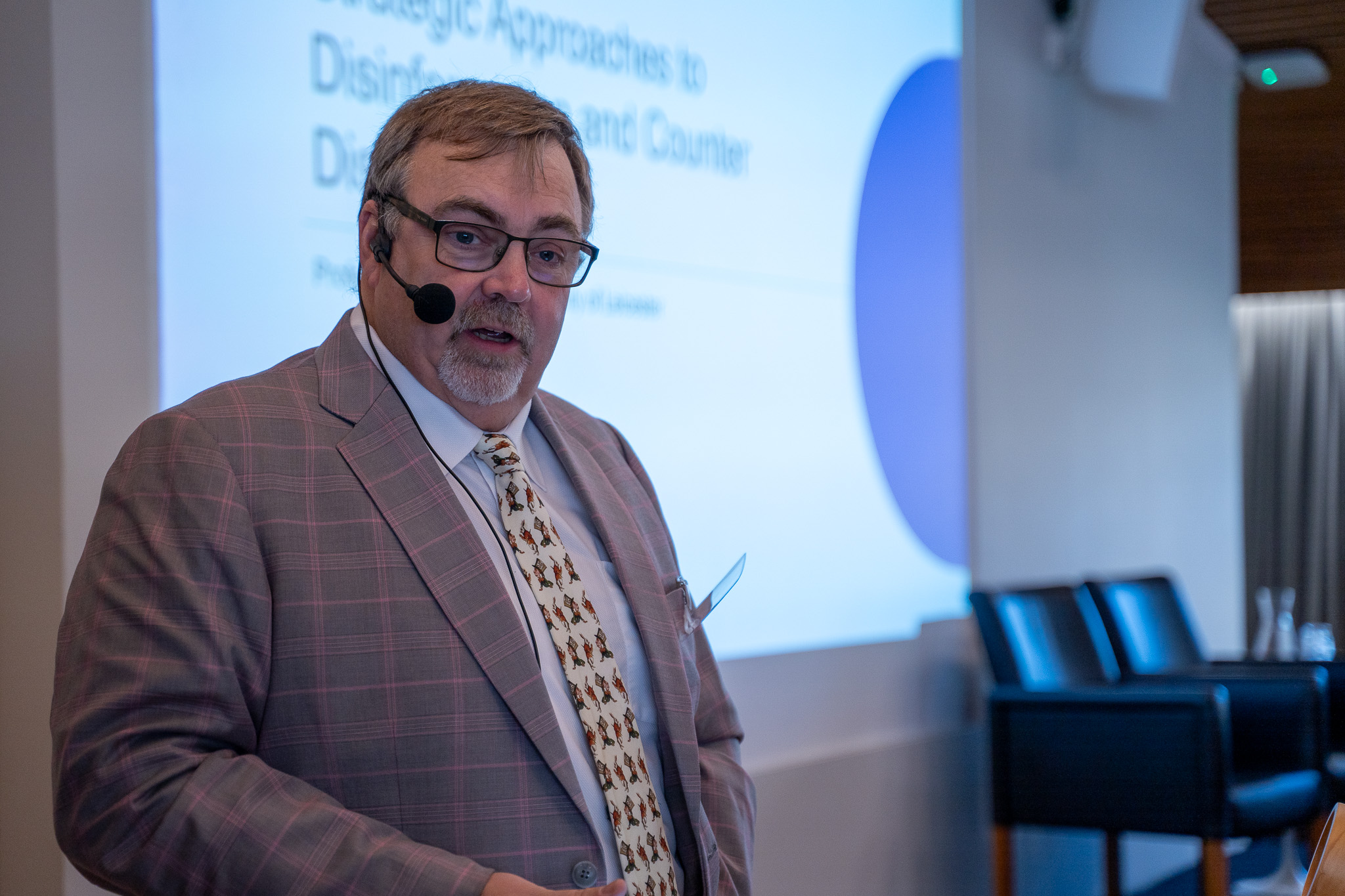
However, China’s and Russia’s attempts to change international rules may require support from non-aligned countries to create a larger bloc for lobbying against the West. While this has been partly successful, large non-aligned countries like India and South Africa have greater influence and agency in negotiating their response to Chinese or Russian narratives.
“They represent a model of the way forward for non-aligned countries, which is probably why hostile state actors look to damage Western interests in those countries,” Professor Baines said in a follow-up interview.
He went on to outline approaches to countering disinformation campaigns, including defensive measures, offensive means and counter-messaging, as well as measures to develop policy and strengthen regulatory and economic deterrence. Given the billions spent by adversaries, Professor Baines is concerned that current efforts by democracies to address disinformation threats may not be enough.
When asked about his top concern, Professor Baines pointed to the sheer volume of activity in recent disinformation campaigns: “Combine social media and AI, and you get the ability to persuade large volumes of people in a hyper-personalized, microtargeted way very quickly.”
Russia: a well-funded ecosystem
Teah Pelechaty is a Senior Analyst focusing on disinformation in Hybrid CoE’s Community of Interest on Hybrid Influence.
She presented the findings of a forthcoming Hybrid CoE report by Jakub Kalensky and Eginhards Volans, two former Hybrid CoE members.
The report examines Russia’s disinformation system, dividing it into four main components:
- orchestrators, operating at the state level;
- intermediaries, or “middlemen”, making up the intermediary dimension;
- executors, including media and the social dimension;
- censors.
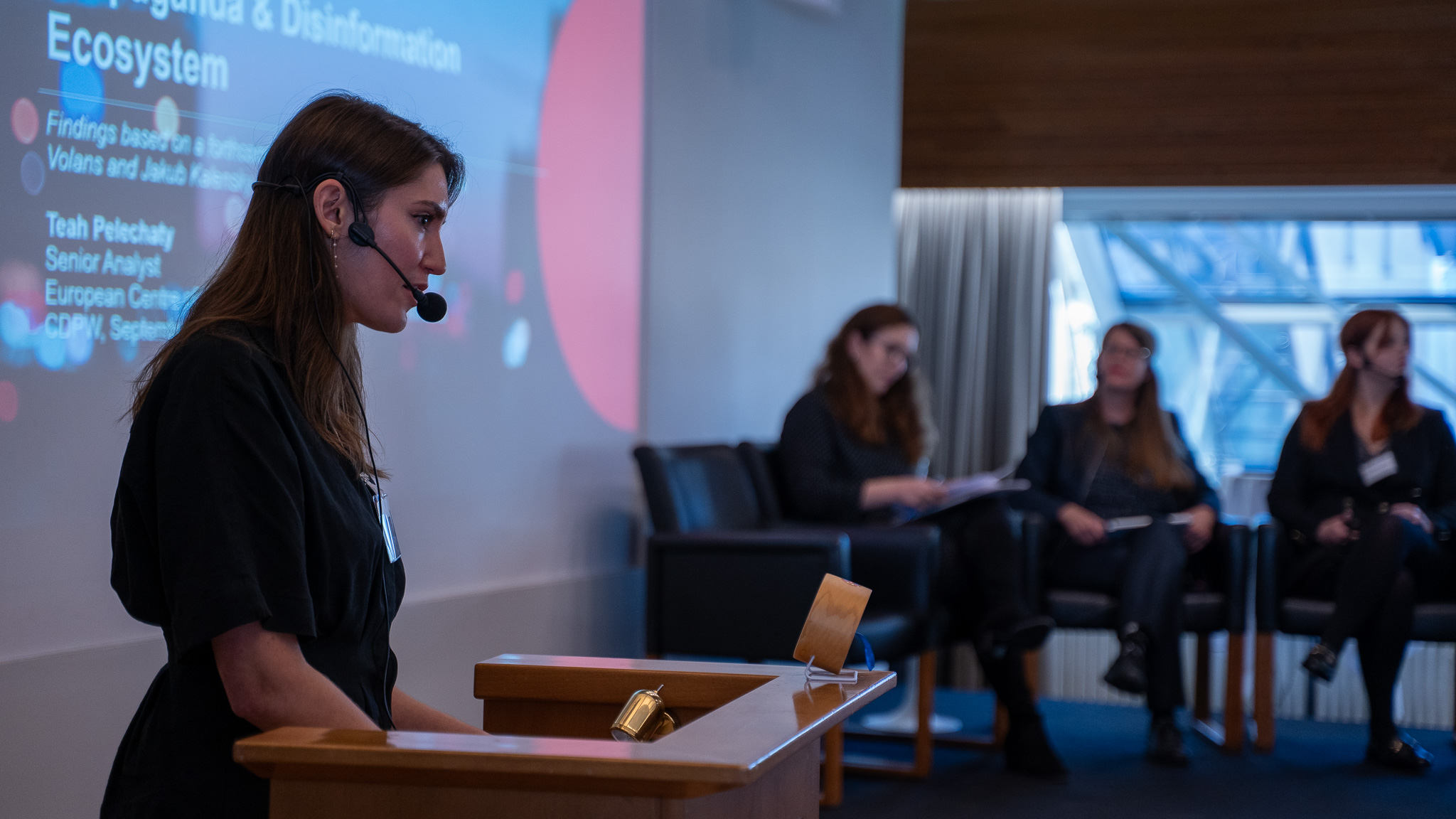
Ms Pelechaty described Russia’s disinformation machine as a centrally controlled yet decentralized system, held together by funding, patronage and various networks. Russia spends vast amounts operating this system, including through overt, covert, classified and private spending. Although some spending is difficult to trace, the baseline estimate for the total cost of Russian disinformation operations is around USD 7 billion.
To counter influence operations generated by this complex and well-funded ecosystem, Ms Pelechaty recommended targeting the system instead of its outputs, as well as strengthening institutional resilience to mitigate the underlying conditions on which it feeds.
Russia’s disinformation ecosystem will be discussed further in a forthcoming Hybrid CoE publication.
China and Russia: different approaches
Dr Ivana Karásková leads the China Team at the Association for International Affairs (AMO) in Prague and is the founder of a network of China experts. She discussed China’s distinctive approach to disinformation and how its methods differ from Russia’s.
Dr Karásková said that China considers the mission of spreading its narratives to be more important than any single means of doing so. Since the Covid-19 pandemic, China’s defensive narrative has shifted towards a more offensive approach, as it began spreading disinformation about the origin of the pandemic, and later about the root causes of the war in Ukraine.
In a post-talk interview, Dr Karásková explained: “China has started to align with Russia on messages and narratives. But more importantly, it has begun to emulate Russian techniques, using human assets who are vocally pro-China and who were pro-Russia before the full-scale invasion of Ukraine.”
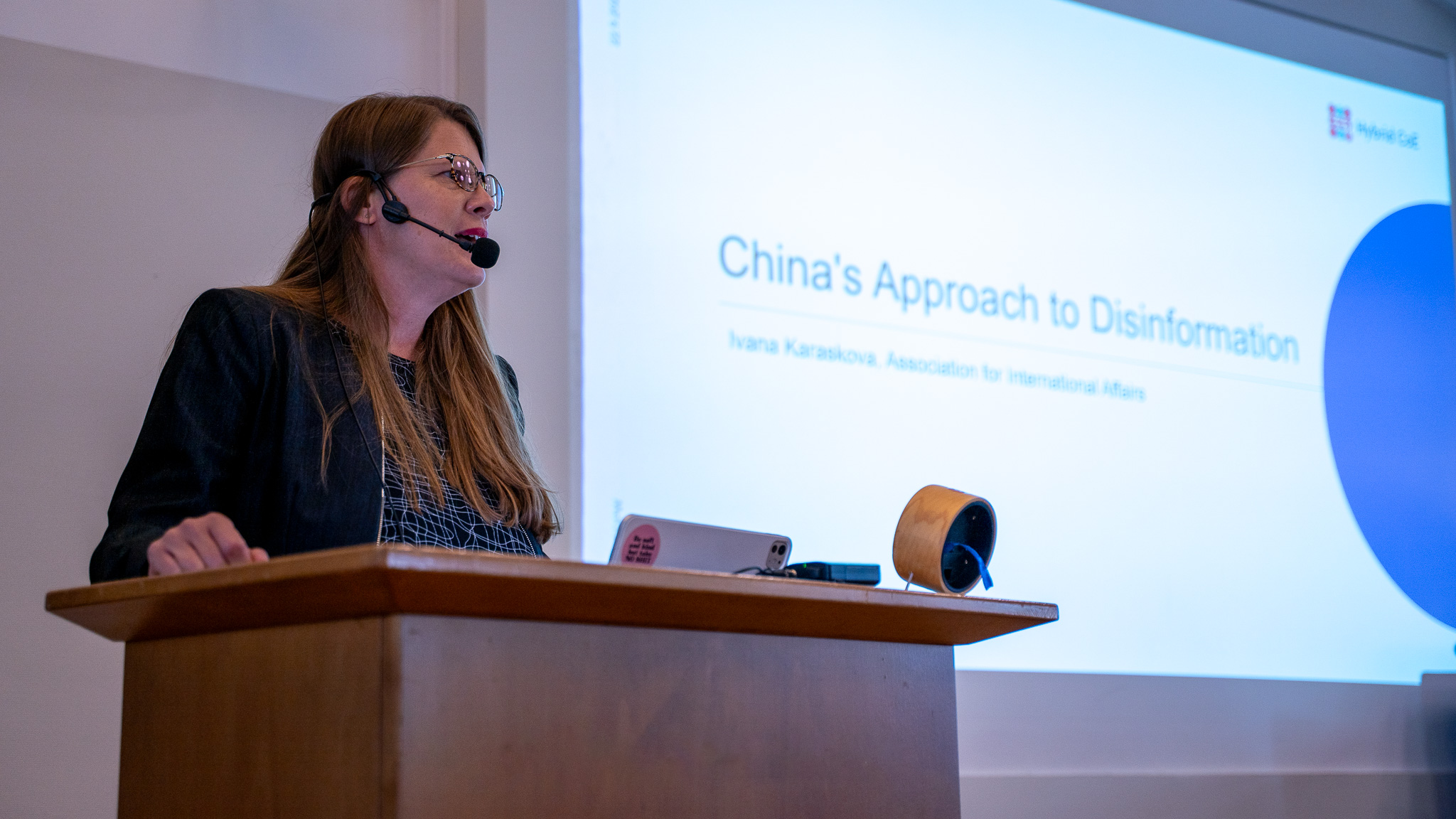
China maintains a whole-of-society approach to disseminating its narratives globally. It blurs the lines between areas such as propaganda, disinformation and public diplomacy. Public relations is used as a means of conveying propaganda and political messaging in connection with Chinese companies.
In such an environment, Dr Karásková advocates responding to narratives that are directly harmful: “We shouldn’t necessarily take down every narrative. But when they’re directly targeting our security, such as influencing NATO countries’ ability to mobilize in the event of conflict, governments should pay attention.”
According to Dr Karásková, China has become more creative in recent years. While Russia is still a more significant threat actor for many countries in the Euro-Atlantic region, China is developing quickly and saturating the information environment with its messaging. This material is now being used to train large language models (LLMs), which power many generative AI systems.
Iran’s fragmented disinformation ecosystem
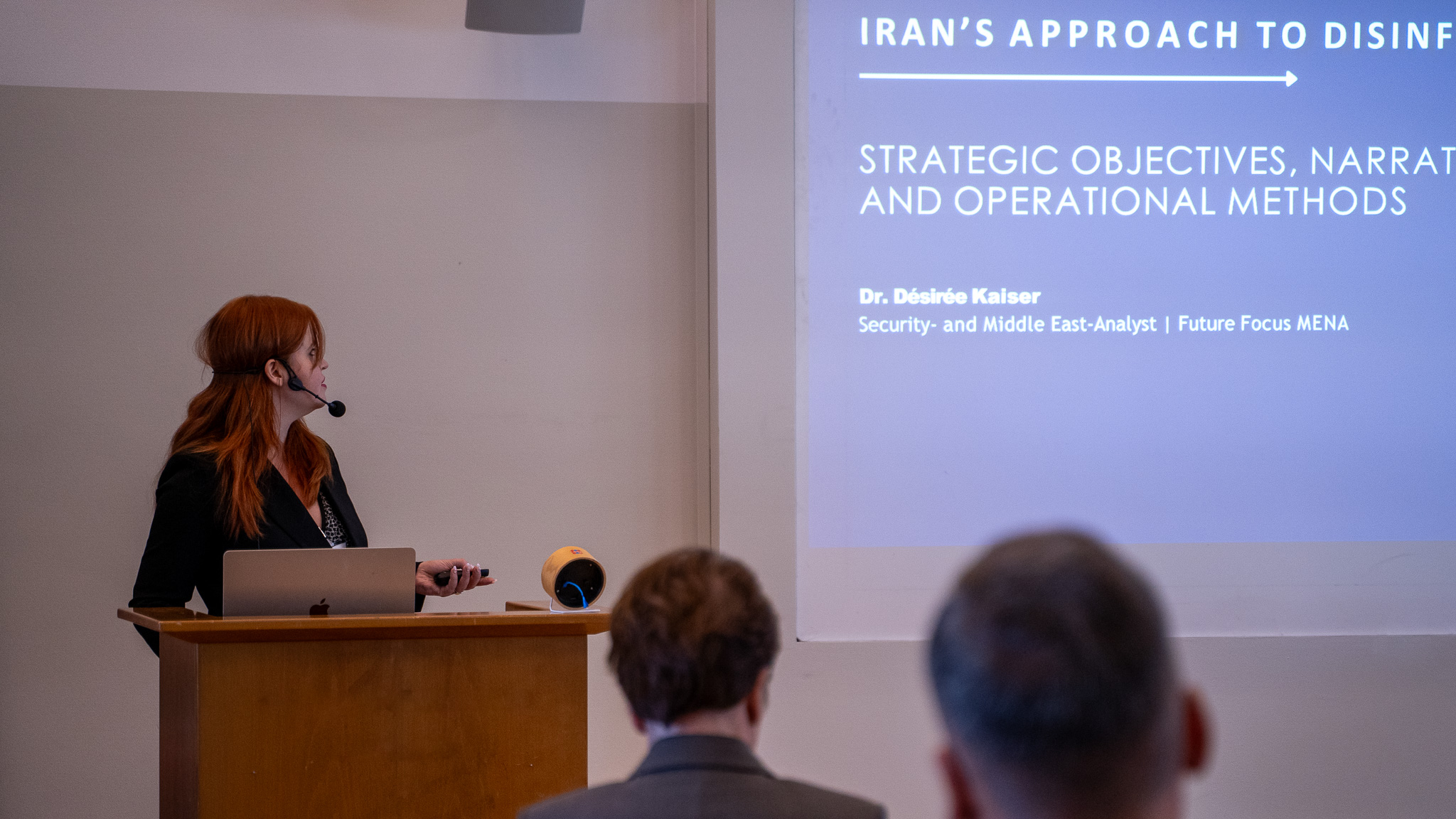
Dr Désirée Kaiser is a Middle East and Gulf analyst and founder of a consultancy providing strategic intelligence, advisory services and training. Dr Kaiser described Iran’s fragmented but connected disinformation ecosystem, which spans state institutions such as the IRGC and state broadcasters; intermediaries such as proxy media and cyber actors; and target audiences such as domestic and diaspora groups, as well as politically divided Western societies.
When asked about Iran’s collaboration with state and non-state actors, she pointed out that the discussion now goes beyond proxy groups. Beyond non-state armed groups such as Hezbollah or the Houthis, irregular actors make use of troll farms, and there are even actors that have no particular stake in reproducing Iranian narratives. Iran nevertheless uses these proxy-aligned actors to produce and reproduce its narratives.
Dr Kaiser added that this leads to disinformation not only in Iran and the MENA region, but also beyond the region, where its effects can be felt among the Iranian diaspora in Europe and in relation to the war in Gaza.
While Iran can harness new technologies like AI to reduce the cost of its operations, there is no indication that targeted operations using AI alone have necessarily increased its influence. Iran nevertheless continues to test new operational practices, using various actors in its fragmented ecosystem to advance its goals.
The sessions also addressed the implications of AI-enabled disinformation operations as a future challenge, as well as ways of using AI to counter them. Other perspectives included a presentation of a platform that uses machine learning to monitor, visualize and respond to disinformation operations, and case studies on using fact-checking to uncover Russian influence operations.